

- TRUBKOVA MATICE (M)
- PŘÍMÁ REDUKČNÍ SPOJKA (ER)
- PRODLOUŽENÁ PŘÍMÁ SPOJKA (K)
- PRODLOUŽENÁ ÚHLOVÁ SPOJKA (L)
- PŘÍMÁ SPOJKA S O-KROUŽKEM (EDKO)
- T-SPOJKA (G)
- ÚHLOVÁ SPOJKA (F)
- ZÁTKY (VSCH)
- ZÁŘEZNÝ PRSTÝNEK (S)
- PŘÍMÁ SPOJKA (E)
- PŘIPOJENÍ DO MANOMETRU (P-MAV)
- PŘIPOJENÍ S TĚSNĚNÍM (BANJO)
- ZÁSLEPKA (STO)
- KŘÍŽOVÁ SPOJKA (H)
- VADKO
- VCDKO

How does hydraulics work? And what exactly is hydraulics?
We encounter hydraulics every day, even when we do not see it. It lifts heavy loads, controls excavator arms, helps brake vehicles, powers large presses in factories and drives many other machines in heavy industry and manufacturing.
Hydraulics is a fascinating field that can transfer enormous forces using what seems to be an ordinary fluid. In this article, we will look at the absolute basics in a way that anyone can understand.
What Is Hydraulics?
The word “hydraulics” comes from Greek: hydor meaning water and aulos meaning pipe. Today, however, water is rarely used in industrial hydraulic systems because of corrosion and freezing. Instead, special hydraulic oils are used.
A simple technical definition is:
Hydraulics is a technical field that uses the mechanical properties of fluids to transfer energy and control forces.
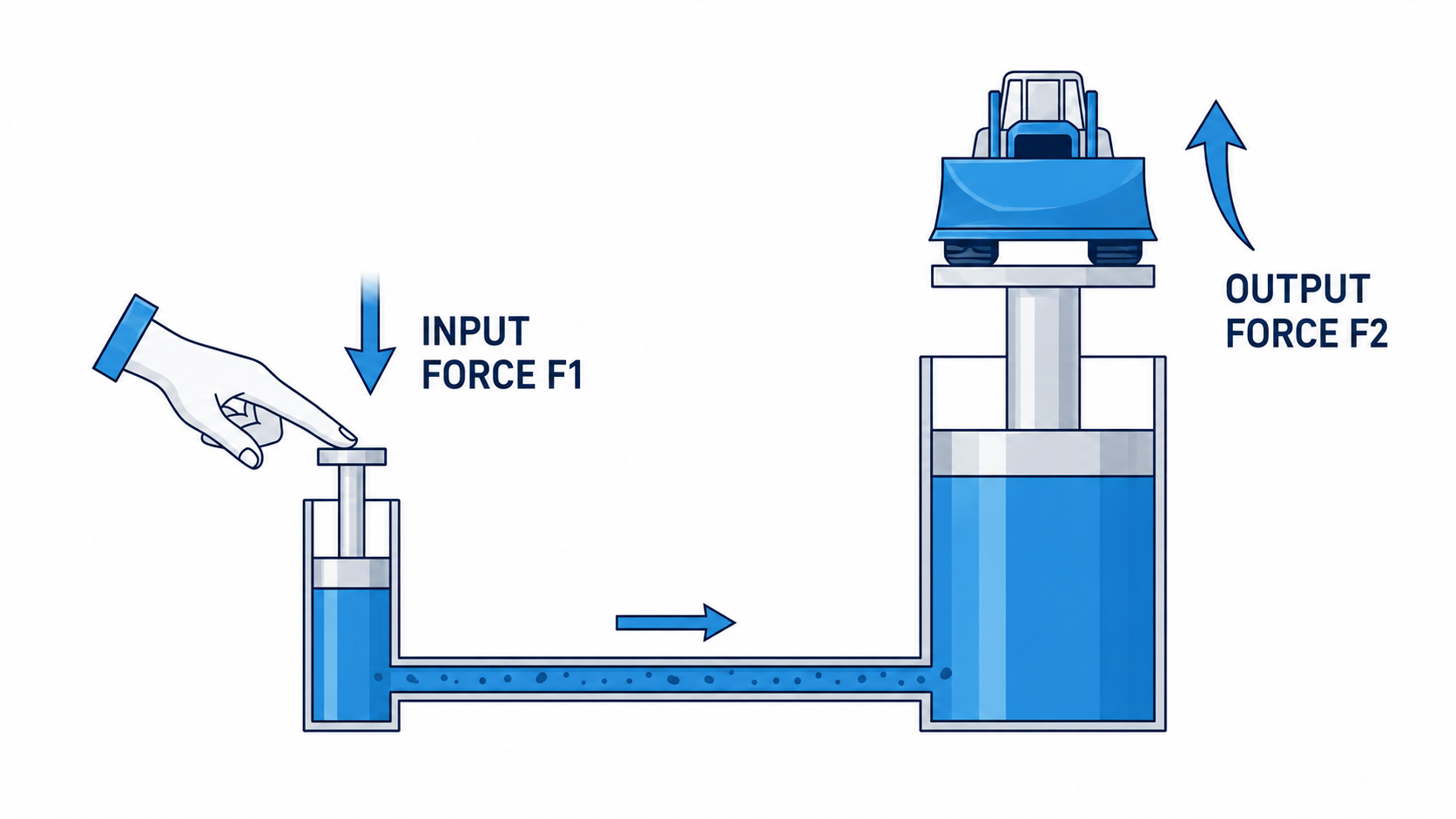
In simple terms, the fluid works like a rod, chain or mechanical link. When force is applied on one side, the fluid transfers that force through the system and something moves on the other side.
Basic Hydraulic Terms
Before we look at the principle itself, it is useful to understand a few basic terms. In hydraulics, the three most important values are pressure, flow and force.
1. Pressure — p
Pressure is the force acting on a specific area.
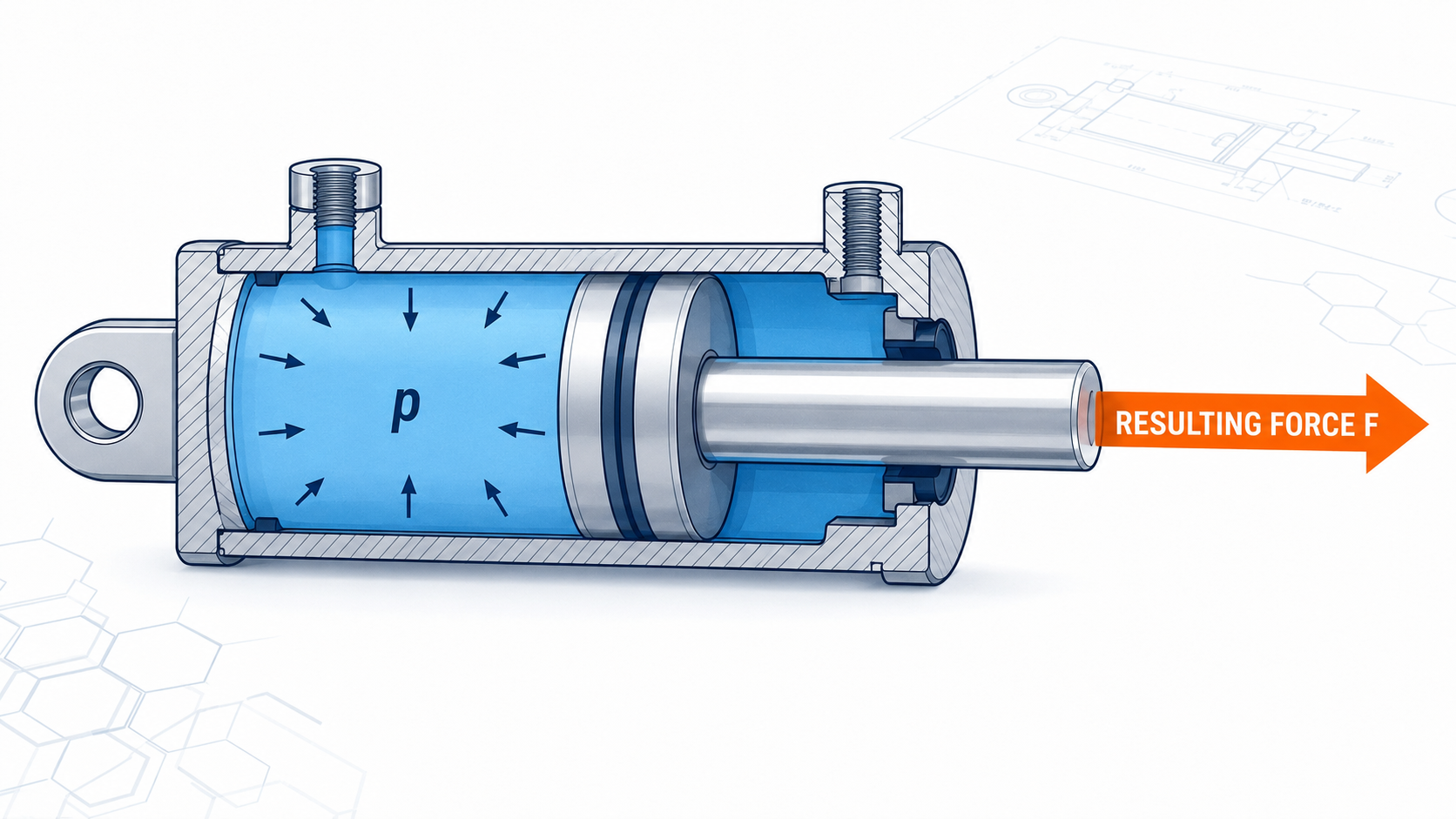
You can imagine it as “tension” inside the fluid. The higher the pressure, the greater the force a hydraulic cylinder can produce.
Common units:
- Pascal [Pa]
- Bar [bar], which is most commonly used in practice
2. Flow — Q
Flow is the amount of fluid that passes through a specific point over a certain period of time.
Flow determines how fast a piston moves or how fast a hydraulic motor rotates.
Common units:
- cubic metres per second [m³/s]
- litres per minute [l/min], which is most commonly used in practice
3. Force — F
Force is the result we need from the hydraulic system — for example, lifting a load, pressing material or moving a machine part.
Common unit:
- Newton [N]
The basic rule is simple:
Pressure creates force. Flow creates speed.
The Basic Principle: Why Does Hydraulics Work?
The whole principle of hydraulics is based on one simple but powerful law of physics: Pascal’s law.
Pascal’s Law: The Foundation of Hydraulics
Pascal’s law says that pressure applied to a fluid in a closed container is transmitted equally in all directions throughout the fluid.
What does that mean in practice?
Unlike air, fluid is almost incompressible. When you push on fluid in one part of a closed system, the pressure is transferred through the system almost immediately.
This is what makes hydraulics so effective.
A small force can act on a small area, such as a small piston. The fluid transfers the pressure to a larger area, such as a larger piston. Because the pressure is the same throughout the system, but the second piston has a larger area, the resulting force is much greater.
This is why hydraulic systems are able to lift, press and move very heavy loads.
A Little Necessary Mathematics: The Basic Formula
Do not worry — there is only one formula. It is the most important relationship in basic hydraulics and describes the connection between force, pressure and area.
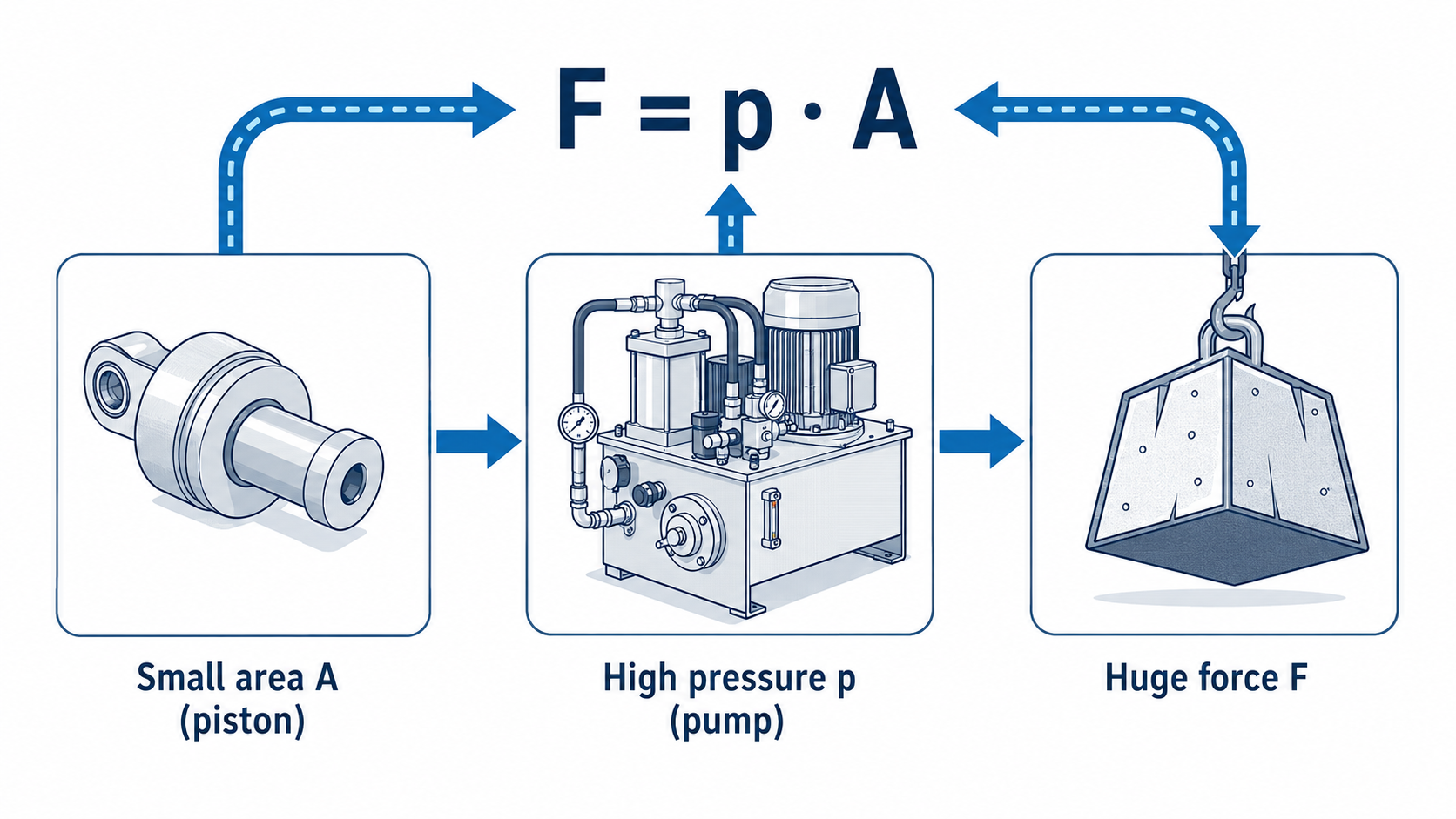
F = p × A
Where:
- F = resulting force [Newton]
- p = pressure [Pascal / bar]
- A = piston area on which the pressure acts [m² / cm²]
What does this mean?
If you want to lift a heavier load or increase the force, you have two main options:
- Increase the system pressure.
- Increase the piston area by using a larger hydraulic cylinder.
A higher pressure or a larger piston area means a greater output force.
Conclusion: Hydraulics Is All Around Us
In this first part, we covered the absolute basics.
We learned that hydraulics transfers force through fluid, that pressure creates force, flow creates speed, and that the whole principle works thanks to Pascal’s law.
In the next part of this series, we will look at the individual components of a hydraulic circuit — what a pump does, what a directional valve is used for and how a hydraulic motor works.
Do you have a technical question about hydraulics, or do you need to design a specific hydraulic or industrial system for your project?
The Interfluid team is ready to help.